

Renault's electric record vehicle travels over 1000 km without charging
Renault undertook a long-distance test with a special electric vehicle. The car traveled over 1000 kilometers without charging.
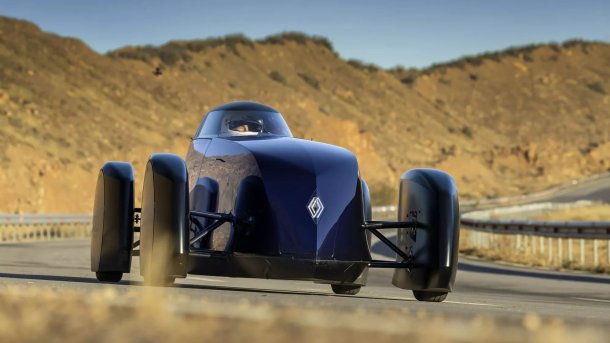
Renault Filante Record 2025 on the test track
(Image: Renault)
Record drive with a retrofuturistic test car: French automaker Renault has, according to its own statements, set an efficiency record with the electric demonstration vehicle Filante Record 2025, which is a homage to a record car from the 1920s.
With the Filante Record 2025, it was possible to "demonstrate the performance of modern electric mobility", Renault announced. The vehicle completed 239 laps on the UTAC test track in Morocco without a charging stop, covering 1008 kilometers – the only stop was a driver change that lasted seven minutes. According to Renault, the vehicle consumed just 7.8 kilowatt-hours per 100 kilometers. The drive, which took place on December 18, lasted less than ten hours, with an average speed of 102 km/h.

Renault provides no information about the vehicle's powertrain. The battery has a capacity of 87 kilowatt-hours and comes from a production vehicle, the current Scenic E-Tech Electric Long Range. At the end of the drive, the charge level was still eleven percent. According to Renault, this would have been enough for another 120 kilometers.
Homage to old record cars
The Renault Filante Record 2025 is a single-seater vehicle with exposed wheels. The design is inspired by two previous record vehicles from Renault – the 100-year-old 40 CV and the Étoile Filante (Shooting Star) from 1956 – with which the French company hunted for speed and long-distance records.
The Filante Record 2025 is 5.12 meters long, but only 1.71 meters wide and 1.19 meters high. The aerodynamic body and special friction-reducing tires are intended to contribute to the vehicle's efficiency, as are electronic steering and brakes (Steer-by-Wire and Brake-by-Wire) instead of conventional mechanical ones.
The aerodynamics are inspired by aviation: the shapes are derived from high-performance aircraft. The dome over the driver's seat resembles the cockpit of a fighter jet. It has been further improved since the vehicle's presentation at the beginning of the year.
Videos by heise
Sailcloth seat saves weight
Weight was also optimized: the entire vehicle weighs about one ton, of which 600 kilograms are accounted for by the battery alone. To save weight, the body was made from lightweight materials such as carbon fiber-reinforced composite materials or a special aluminum alloy. The driver's seat is made of sailcloth.
While the battery comes from a production vehicle, the construction is different: in the Filante, the cells are not packed into modules but are integrated directly into the battery pack (Cell-To-Pack, CTP). The battery thus becomes part of the body, saving weight and utilizing space better.
However, the design, technologies, and performance are "not an end in themselves and far more than a technical exercise," Renault emphasized. The findings from the record drive are intended to "flow into the development of future electric road vehicles."
(wpl)