

On the road in the Mercedes CLA with Level 2++: Supervised Autonomy
Mercedes offers Level 3 in series production, but also works on Level 2++ in parallel, for good reasons.
(Image: Mercedes)
- Wolfgang Gomoll
- Martin Franz
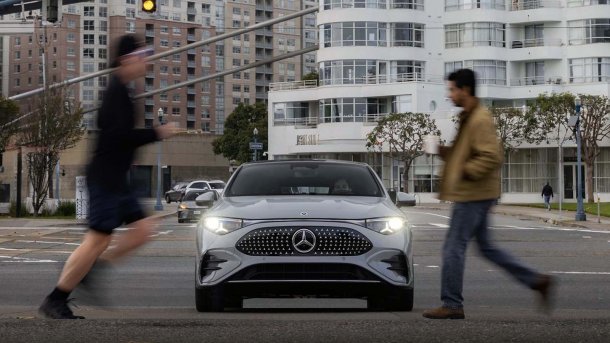
Is a U-turn now coming? Of all brands, Mercedes, one of the few currently offering series production of highly automated driving at Level 3, is working on a system where the driver must be able to intervene at any time and always remains responsible. We were able to test a CLA with Level 2++ on the streets of San Francisco. It becomes clear that development is proceeding in different directions in many areas and that there are good reasons for this.
After a few years in which there seemed to be hardly any significant progress, the vision of autonomous driving is gaining momentum towards series production again. Development is currently being somewhat slowed down by very different legislation around the globe. China and the USA are more lenient than Europe and are already working on fully automated driving at Level 4. At the same time, Tesla is demonstrating what is possible with camera-based systems and Level 2++. My colleague Christoph M. Schwarzer recently tested this in Hamburg.

Levels of Automation
The distinctions between different levels of driving automation seem to be blurring, but the essential differentiating features remain valid. No matter how many characters follow the two: the driver always remains responsible, regardless of the extent to which driving automation supports them. In the case of the Tesla test drive mentioned by my colleague, the support is so extensive that this fact can sometimes fade into the background.
From Level 3 onwards, the car can handle situations on its own in at least one scenario, the framework conditions of which can be defined by the manufacturer. However, the driver must be able to take over control again at any time with a few seconds' transition period. It is obvious that Level 3 will initially be implemented where situations are generally clear and reasonably predictable. A dry highway in daylight is such a case.
Learning from Data
Level 4 practically only changes one thing: the driver no longer has to intervene in this one scenario. In the precisely defined environment set by the manufacturer, the car can handle everything on its own. For the sake of completeness: Of course, manufacturers are free to enable automated driving in more than one scenario at both levels. With each step up in this hierarchy, the control effort increases enormously, and so does the responsibility of the manufacturers. This makes the systems expensive, which is why Mercedes is also working on Level 2++ in parallel. Lower costs promise greater adoption on the one hand, and on the other hand, they open up the possibility for the manufacturer to learn from collected data. This, in turn, benefits systems that promise to cope on their own in certain situations.

(Image: Mercedes)
Mercedes has good reasons for its approach. Instead of relying solely on Level 4 autonomous driving, the brand is pursuing a conservative path in parallel with various partners. In the USA, Mercedes cooperates with Nvidia for its Drive Assist Pro system, and in China with the local AI/software company Momenta. The regulatory and political climate made the variable use of partners necessary. It is remarkable that Nvidia's Robotics Director Jim Fan, after a drive with Tesla's FSD v14 ("Full Self-Driving"), stated that at times he could hardly distinguish whether a human or the neural network of a machine was driving.
Interventions are Analyzed
The end-to-end approach in autonomous driving is data-driven, uses AI, and acts based on the learned model. At Nvidia and Mercedes, these two models run in parallel: the end-to-end model is the idea generator for driving, and the classic model monitors and checks if everything is correct. The car learns with every meter, so to speak, especially when the driver has to intervene. Critical situations are recorded, and the camera images along with the sensor data are analyzed by humans. The Nvidia programs then simulate numerous variations of each incident, which are then fed back into the car.
Powerful Hardware
Nvidia's processor delivers up to 254 TOPS, which is relevant for AI computing power. This is supplemented by over 600 GB of flash memory. Ultimately, the Mercedes CLA, which is intended to perform these tasks, is a software-defined vehicle. This is also evident in the sensor equipment of the Mercedes CLA. Among other things, a telephoto and wide-angle front camera are installed for a "dual view" to the front. Wide-angle for close range or overview, and telephoto for more distant objects. In addition, there are four surround cameras for 360-degree visibility and four side cameras that monitor cross-traffic and blind spots when changing lanes. What is missing is an expensive LiDAR sensor. Additionally, a high-speed data network with a transfer rate of 2.5 Gbit/s is required. The currently current 5G standard delivers a maximum of ten Gbit in download and up to two Gbit in upload.
Videos by heise
Convincing Performance
On the road with a pre-series system in the Mercedes CLA, it quickly becomes clear: this is, logically, not a daredevil. The computer recognizes that another vehicle is pulling out of a parking space and politely makes way. It signals to change lanes, lets others pass, and then moves over. You notice that the machine has learned how things work in the urban jungle when cars are parked on the right side of the road. Then the Mercedes proactively moves to the left, as experience shows that things move faster there. It is interesting that another test vehicle, equipped with identical software and sensors, follows a different strategy for lane changes and sometimes changes lanes faster or stays in them longer.

(Image: Mercedes)
Overall, the assisted driving in the Mercedes delivers a convincing performance. Red lights, stop signs, including the US rule "first come, first served," and pedestrians who simply walk across the street are reliably recognized. Like a human driver, the system takes its foot off the gas, checks the situation, and then continues. However, not everything is running smoothly yet. When a car is blocking the oncoming lane and other vehicles want to pass it, the Mercedes drives a bit too close to oncoming traffic. When turning left, the autopilot stays in its lane, even though the other lane would have been free.
Much Remains to Be Done
During the 45-minute test drive, there were three situations that the system did not resolve perfectly. It never became dangerous. Furthermore, Mercedes still has almost a year until Drive Assist Pro is to be offered. In a test in Stuttgart, the system made the correct decision 90 percent of the time, says Christoph von Hugo, Head of Active Safety at Mercedes. In other words, in one out of ten situations, the driver would have had to intervene. So, the developers still have a lot to do before series production, even though the demonstration in San Francisco's rush hour traffic undoubtedly provides an impressive glimpse of what's to come.
(mfz)