

Electric micro-transporter Hudson eBuddy: New addition for last-mile logistics
An L7e-class e-transporter from China is set to compete with the Fiat Tris and Piaggio Porter. Based on its specs, the Hudson eBuddy is capable.
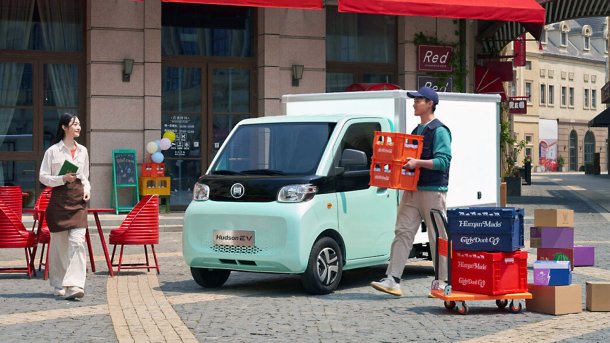
Electric micro-transporter Hudson eBuddy
(Image: Hudson)
An Austrian importer has recently added an electric micro-transporter, positioned between the Fiat Tris and Piaggio Porter, to its lineup. The Hudson EV eBuddy from Hong Kong is a two-seater transporter in the L7e light vehicle class. It is now being brought to Europe by Holvex Handels GmbH, part of the Heinzl Group in Kammersdorf near Vienna, which has been importing the Horwin brand electric motorcycles from China to Europe for several years. They will present the eBuddy on March 25th and 26th, 2026, at the fleet manager event "Flotte! Der Branchentreff" at the Messe Düsseldorf trade fair.
The company hopes for a sustainably growing sales market for such vehicles in so-called "last-mile logistics," where deliveries must be made within emission-controlled city centers. In these areas, vehicles with combustion engines are not allowed or are only permitted with restrictions due to exhaust and noise pollution, with a growing trend in both restrictions and coverage.
Agile and locally emission-free
Furthermore, city centers often translate to old towns, with typical restrictions on street width and load-bearing capacity. Vehicles with a small footprint and a tight turning radius have an advantage here, which is incidentally the only reason Fiat continues to equip its Tris with a single front wheel. This allows the vehicle to turn practically on the spot. As four-wheel designs, the Piaggio Porter and Hudson eBuddy offer significantly better driving dynamics and are also allowed to drive faster. To keep the turning radius as small as possible, both are rear-wheel drive.
Hudson eBuddy (5 Bilder)

Hudson
)The eBuddy measures 3820 by 1480 mm and, in its version with a cargo box, is still under two meters high, allowing it to enter standard underground garages and multi-story car parks. In addition to last-mile logistics, the importer sees applications in agriculture and forestry, construction, as a municipal vehicle, and on industrial sites. As a locally emission-free vehicle, it can also be used permanently in greenhouses and halls.
30 kW and 71 km/h
In terms of construction, the eBuddy adheres to the concept proven in automotive engineering for over 100 years, with a ladder frame made of sheet steel profiles, a rigid rear axle guided only by leaf springs, and a front suspension with lower wishbones. The electric motor, directly flanged to the rear axle, offers 15 kW continuous and 30 kW peak power and up to 110 Nm of torque virtually from a standstill. This allows the transporter to reach a top speed of 71 km/h – more than sufficient for city traffic.
The 15.4 kWh lithium iron phosphate (LFP) battery, mounted in the center of the vehicle between the frame side members, is said to provide a range of up to 150 kilometers. The supplier states the charging time is around eight hours. Brake energy recuperation is standard; a fast-charging option or battery conditioning are not offered – as with competing products. While LFP cell chemistry may not offer the highest charging performance, especially in cold weather, it is inexpensive, robust, and safe against thermal runaway. The workhorse among battery technologies is therefore a consistent choice for heavily used commercial vehicles.
For the 3.82 meter version with the 2 by 1.4 meter flatbed, Hudson specifies an unladen weight of 850 kilograms and a permissible gross weight of 1.7 tons, resulting in a payload of 850 kilograms. The equally long version with a closed cargo box measuring 2045 mm in length, 1420 mm in width, and 1195 mm in height, with a volume of 3.47 cubic meters, weighs 910 kg, reducing the payload to 790 kilograms. Both versions are said to offer space for two Euro pallets. The two-part rear door of the cargo variant can be opened up to 270 degrees per wing and locked to the side wall from the outside.
Videos by heise
Standard equipment includes power steering, electric brake booster, ABS, air conditioning, rearview camera, electric windows, and USB port. The importer offers a two-year or 50,000 kilometer warranty, and a five-year or 150,000 kilometer warranty on the battery. The two-seater costs 14,900 Euros as a pickup truck, and 1000 Euros more with a transport box instead of a loading area on the frame. The Austrian importer calls this a "sensational price-performance ratio."
