


Radionuclide battery: 50-year life, no charging hassle for phones
Betavolt Technology announced a "revolutionary" compact radionuclide battery based on nickel-63 with 100 microwatts of power and a 50-year lifespan.
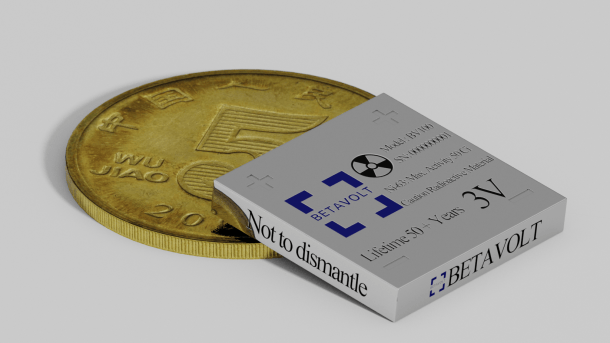
(Image: Betavolt.tech)
The Chinese company Betavolt Technology has announced a 3-volt battery with an output of 100 microwatts in a compact housing (15 mm × 15 mm × 5 mm) that promises a service life of 50 years. The company aims to achieve this with the help of betavoltaics, in which a semiconductor is irradiated with fast electrons produced by the beta decay of an isotope. So far, however, there is only a press release about the battery with a few specifications and 3D images. According to Betavolt, there is still a long way to go from the battery now entering the pilot phase to the point where you "never have to charge your cell phone again" –, although this has not happened before due to the risks involved.
In 2025, Betavolt Technology even wants to bring batteries with an output of 1 watt onto the market. By integrating a supercapacitor into the battery, the battery is intended to serve as a pulse current source with a longer service life. However, it is questionable whether this will work satisfactorily. In modern smartphones, the processor alone can consume 10 to 15 watts of electrical power under full load. Added to this are components such as the radio module and display.
The battery presented uses nickel-63 as an energy source and a diamond semiconductor as an energy converter. Nickel-63 decays to the stable copper-63 with a half-life of 101.2 years, emitting soft beta radiation.
The company also wants to extend its studies to isotopes such as strontium-90 and promethium-147 to develop radionuclide batteries with higher performance and a service life of between two and thirty years. The company sees smartphones, drones and medical technology (pacemakers, artificial hearts, cochlear implants) as potential applications for such batteries, provided that this is permitted by politicians. According to Betavolt Technology, the developments are in line with China's 14th Five-Year Plan and the "Vision 2035", which envisage both the civilian use of nuclear power and the "multipurpose development of nuclear isotopes as future development trends".
The core battery consists of a converter, a substrate, the nickel-63 source and a cell protection layer. The nickel-63 diamond β-volt battery has a modular design and achieves an energy conversion rate of 8.8 percent, according to Betavolt Technology. The company has developed a single-crystal diamond semiconductor that is only 10 micrometers thick. According to Betavolt Technology, a two-micrometer-thin nickel-63 layer is located between two diamond semiconductor converters, which convert the decay energy of the radioactive source into electric current.

(Image: Betavolt Technology)
How it works
The electrons released as beta radiation during the radioactive decay of nickel-63 are intended to generate secondary charge carriers in the p-n junction of the diamond semiconductor. A space charge zone field causes a separation of the charge carriers. It arises at the interface between the differently doped areas in the semiconductor and acts like a barrier that separates the charge carriers generated by the beta radiation. This separation takes place against an externally applied voltage, whereby the movement of the charge carriers can be controlled and thus electrical energy can be generated.
Videos by heise
Origins in the 1960s
Radionuclide batteries are not new: since the 1960s, thermal energy from radioactive decay has been converted into electrical energy during space missions using so-called thermoelectric generators (radioisotope thermoelectric generators, RTGs). The Mars rover Curiosity, which has been driving around on Mars for NASA since 2011, also uses a radionuclide battery with around five kilograms of plutonium dioxide.
Pacemakers are an early example of radionuclide batteries in medical technology. In the 1970s, Larry C. Olsen developed the promethium-117 battery "Betacel" at McDonnell Douglas. Despite its innovative approach, the Betacel battery was not widely used due to its limited lifespan and concerns about the use of radioactive material. In recent years, however, there have been repeated attempts, including with nickel-63.

Although the beta radiation from the isotopes used can be easily shielded, there is a risk of radioactive leakage if the battery is damaged or improperly disposed of, and the long life of the battery could lead to long-term exposure to low doses of radiation. These risks and the associated environmental impacts require careful testing and certification to ensure their safety. This is why radionuclide batteries are still mostly used only in space or military applications.


(vza)

