


Jupiter's upper atmosphere surprises with complex structures
Jupiter's upper atmosphere around the Great Red Spot was previously thought to be homogeneous. But it doesn't seem to be so boring after all.
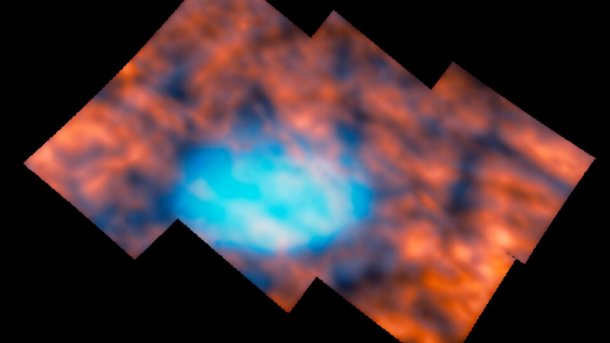
An image taken with the near-infrared spectrograph of the James Webb Space Telescope of the atmosphere around Jupiter's Great Red Spot.
(Image: ESA)
Jupiter's upper atmosphere is not as boring as astronomers previously thought. During a study of the region above Jupiter's well-known Great Red Spot using the James Webb Space Telescope (JWST), scientists found several previously unseen features. This was announced by the European Space Agency (ESA) on Tuesday. Apparently, this region is home to various complex structures and activities.
Unlike geostationary telescopes, the JWST allowed scientists to observe and study Jupiter's upper atmosphere above the Great Red Spot in detail. The upper atmosphere is considered to be the connection between Jupiter's magnetic field and the lower atmosphere. Brightly shining northern and southern lights can be seen there, which are caused by volcanic ejections from Jupiter's moon Io. However, the structure of the upper atmosphere in the equatorial region is influenced by incident sunlight. Until now, astronomers have assumed that this region is homogeneous, as Jupiter receives only four percent of the sunlight compared to Earth.
The investigations above the Great Red Spot took place in July 2022 as part of the Early Release Science Program (ERS) and were published in the scientific paper "Ionospheric irregularities at Jupiter observed by JWST", which appeared in Nature Astronomy.
Videos by heise
For their investigations, the researchers used the near-infrared spectrograph (NIRSpec) of the James Webb Space Telescope and the capabilities of the Integral Field Unit. The astronomers did not discover a cloudy upper atmosphere, as previously assumed, but one with many complicated structures, such as dark arcs and bright spots, as the ESA writes. These are said to extend over the entire field of view.
No boring upper atmosphere
The scientists were surprised by this finding, as they assumed that this region could be "boring". "In fact, it's just as interesting as the Northern Lights, if not more so," says Henrik Melin, planetary scientist at the University of Leicester and leader of the research team. "Jupiter never ceases to surprise."
The scientists assume that the sunlight-driven light emanating from this region is not solely responsible for the changes in the shape and structure of the upper atmosphere. The astronomers suspect that one possible explanation for the changes is gravitational waves that arise in the turbulent lower atmosphere around the Great Red Spot and move upwards from there. They could thus influence the upper atmosphere and change its structure and emissions.

If possible, the research team wants to carry out further observations with the JWST. They hope to find out more about the complex wave patterns. Of particular interest is how the waves move in the upper atmosphere. The scientists hope to gain insights into the energy balance of the region and the temporal changes in activity.


(olb)

