

Electric car Renault Trafic E-Tech: First Renault with 800-volt battery
In the Trafic E-Tech van, Renault's 800-volt architecture will first hit the road at the end of 2026. The premiere is on November 18 at the Solutrans trade fair.

(Image: RECOM Paris, Renault Design)
In a van the size of the VW ID. Buzz, Renault's 800-volt architecture will first hit the road at the end of 2026. The battery-electric panel van is the first harbinger of Renault's 800-volt architecture, which is intended to accelerate charging and enable a range of up to 450 km in WLTP. Developed by Ampere, Renault's in-house engineering service provider for electric cars, the Trafic also offers a scalable architecture as a so-called Software Defined Vehicle with cloud-based software and over-the-air updates.
Renault Trafic E-Tech Exterieur (6 Bilder)

RECOM Paris, Renault Design
)Renault describes the Trafic as the fourth generation of the van, which has sold more than 2.5 million units since 1980, although it was significantly larger. It is the first model in a series of battery-electric commercial vehicles that, with the revived names Estafette, Goelette, and Trafic, are intended to offer alternatives to the vans and panel vans from VW, Peugeot, Opel, and Kia in various sizes.

Initially as a panel van from 2026
Initially, Renault will offer the Trafic as a panel van, later also as a bus with windows and a van, as a platform chassis, flatbed, or cargo box. The height of 1.9 m allows it to enter underground garages. Despite the long wheelbase, the turning circle is no larger than that of a Renault Clio. This promises an advantage for deliveries in urban areas, as does the generous glazing with narrow pillars for good visibility. The cockpit features a 10-inch instrument cluster and a 12-inch screen in the center. Three front seats and generous storage compartments are standard in this segment.
Renault Trafic E-Tech Interieur (4 Bilder)
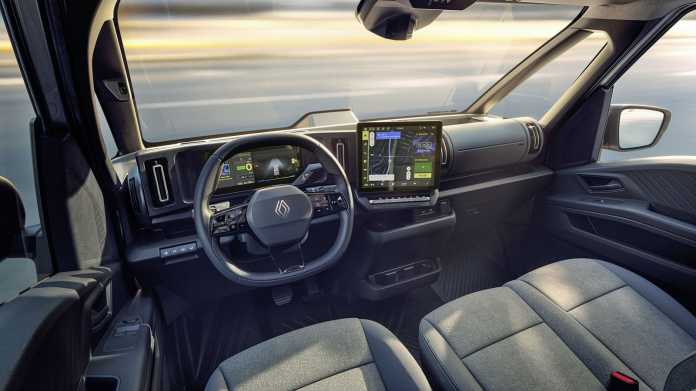
RECOM Paris, Renault Design
)The wheels positioned far in the corners, made possible by the electric drive, improve space utilization. For example, the Trafic L1 panel van offers a cargo volume of 5.1 m3 with a length of 4.87 m and a width of 1.92 m. As an L2, it has a length of 5.27 m and a 40 cm longer wheelbase, offering 5.8 m3. As a van, the Trafic has rear wing doors and side sliding doors. A towing capacity of two tons and a payload of up to 1.25 tons are targeted but not yet homologated.
Videos by heise
800-volt premiere for Renault
From market launch, the Trafic will be equipped with a nickel-manganese-cobalt battery with a maximum range of up to 450 km in WLTP (homologation is still ongoing). Under favorable conditions, the large battery should be able to charge from 15 to 80 percent in about 20 minutes at DC fast-charging stations thanks to the 800-volt architecture, corresponding to a range of 260 km. While this is fast, it is hardly better than the charging performance of the electric panel van Kia PV5 with a 400-volt battery and similar range. Renault has not yet disclosed the charging power for AC charging.
Later, a significantly cheaper lithium-ion phosphate battery with a range of 350 km in the cycle will be offered. Renault has not yet disclosed whether this LFP battery will offer similar fast-charging capability as the NMC battery. At least, it is likely to be at a disadvantage in this regard at temperatures below zero degrees Celsius. A vehicle-to-load function will be available at an additional cost. The electric motor produces 150 kW and 345 Nm.
Some homologations are not yet complete, and Renault has not yet announced an exact first sales date or prices. It can be assumed that the prices will be oriented less towards the very expensive VW ID. Buzz and more towards cars like the Kia PV5. The latter costs around 40,000 euros as a bus and slightly less as a panel van.
(fpi)