

Mercedes C-Class EQ presented: The electric car for long distances
Mercedes presents the electric C-Class with up to 760 km range, all-wheel drive and 360 kW power. A strong package.
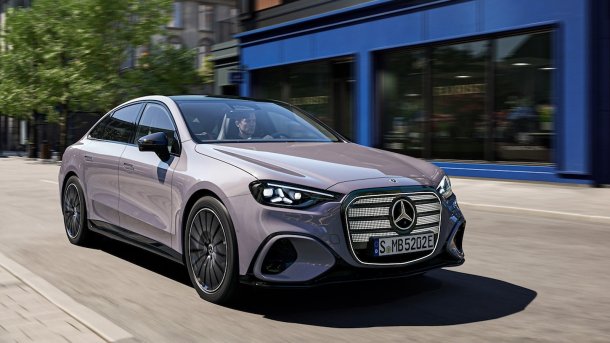
(Image: Mercedes)
Never has it been less important than in an electric car, and yet Mercedes is pulling a huge grille out of the box to set the new generation of electric cars in a typical brand image. How this will be received globally by the respective target group remains to be seen. Technically, however, Mercedes has left no stone unturned. The electric C-Class promises to be an excellent electric car.
Mercedes C-Klasse EQ außen (5 Bilder)

Mercedes
)The technical specifications are already known from the GLC EQ. To start, there will initially only be an all-wheel-drive model with 360 kW and 800 Nm. 4.1 seconds should be enough to reach 100 km/h from a standstill. Mercedes installs a two-speed transmission on the rear axle. This is intended to ensure extreme acceleration in the lower speed range on the one hand and to help improve efficiency on the motorway on the other. The brand is taking the same approach with the smaller CLA EQ, but my colleague Clemens was not completely convinced in his test.

WLTP range of 760 km
In WLTP, Mercedes specifies a range of 760 km. It should be more than 800 km with a C-Class that only has a rear motor and will complement the range next year. In any case, it can be assumed that Mercedes will also increase its offerings in terms of drives and batteries. It is conceivable that there could be a base model with around a 70 kWh battery and a top model with significantly more than 400 kW of power. Those responsible do not comment on either.
Mercedes C-Klasse EQ innen (6 Bilder)

Mercedes
)The C 400 4Matic launch model comes with a 94.5 kWh net battery. Consumption in the cycle is specified as 14.1 to 18.5 kWh. Charging can be done at up to 330 kW, and under ideal conditions, electricity for 320 km in the combined WLTP should be recharged after 10 minutes. Charging from 10 to 80 percent takes 22 minutes, provided the battery is pre-conditioned accordingly and the charging infrastructure can keep up. Charging stations with more than 300 kW are, after all, the exception, not the rule.
Under ideal conditions, this results in an average net charging power of around 180 kW between 10 and 80 percent. Mercedes is not at the forefront here, but one should put the current conditions into expected practical figures: If you start with a full battery, drive down to 10 percent, and then charge to 80 percent, you can expect more than 700 km on the motorway, provided you don't try to complete this in 4 hours and accept a 22-minute break over this distance. I think this creates conditions that are sufficient for almost all usage profiles.
DC charging with 400 volts
In the CLA and GLC, Mercedes has drawn a lot of criticism for the decision to allow charging at DC stations with 400 volts only for an extra charge. For now, this seems to remain the case with the C-Class. AC charging at 11 kW is standard, and 22 kW is available for an extra charge. In some scenarios, such as during a visit to the swimming pool, this is repeatedly quite practical.
Mercedes C-Klasse EQ Technik (4 Bilder)

Mercedes
)Assistance to book
Of course, Mercedes does not stop at a comprehensive, modern drive. The MB.OS operating system is complemented by powerful hardware that should provide enough power for many years to come to handle future tasks. Some assistants can be booked retrospectively, including a proactive lane changer, a special camera perspective to protect the rims, and an assistant that makes driving in city traffic safer.
Videos by heise
As in the CLA, the rear trunk is not overly generous at 470 liters given the exterior dimensions. However, the compartment under the front hood holds a respectable 101 liters. A wheelbase of 2.96 m should allow for excellent interior space, significantly exceeding that of the C-Class with a combustion engine.
And what happens next?
The C-Class will not have an easy time as an electric car. The CLA EQ, placed below it, can charge similarly quickly and is also offered as a station wagon. This is not planned for the C-Class. An electric E-Class is expected from 2027, which will then have to be even more luxurious – without taking away the last customers from the recently revised EQS. Competition from outside the C-Class includes the new BMW i3 (New Class, market launch autumn 2026), which scores with a range of up to 900 km and charging power of up to 400 kW.

Mercedes has not yet commented on the price of the C 400 EQ 4Matic. However, around 65,000 euros can be expected.
(Image: Mercedes)
It should also not be forgotten that the C-Class with a combustion engine is also receiving a model refresh. Like BMW, Mercedes is pursuing a dual strategy in the midsize segment for a few years. This also gives customers the choice of how quickly the transition to driving energy takes place. The initial assessment of this presentation: With the C-Class EQ, Mercedes has presented a package that has the potential to convince many skeptics. And that would probably have worked even without a huge grille.
(mfz)