

VW boss Schäfer: The ID.2 will probably be more expensive than expected
The new ID.2 from VW was originally supposed to cost 20,000 euros. Due to increased energy and raw material prices, it will now cost 25,000 euros.
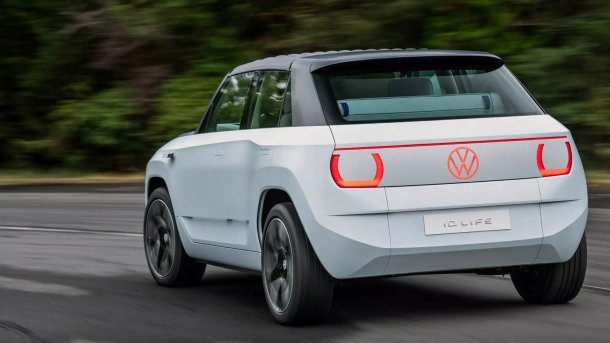
VW will have another electric small car in its range by the end of 2024 at the earliest.
(Bild: VW)
(Hier finden Sie die deutsche Version des Beitrags)
Volkswagen currently has at least one problem: with the Seat Mii electric, Skoda Citigo iV and VW e-Up, the company has in principle exactly what the market is currently demanding en masse. But the electric subcompact cars have not been available to order for some time. Production capacities have been exhausted. The successor VW ID.2 and the expected derivatives of the group brands are still waiting.
More like 25,000 Euro
The ID.2 is scheduled for market launch at the end of 2024 at the earliest, with offshoots from Skoda and Seat likely to follow quickly. As Volkswagen boss, Herbert Diess once announced that he wanted to offer this electric car for around 20,000 euros. VW boss Thomas Schäfer carefully distanced himself from these ambitions in an interview with electrified. How close one comes to the "desirable" 20,000 euros depends above all on the development of raw material prices. If you look at the price increases, Schäfer said, you quickly reach 25,000 euros.
Videos by heise
Cheaper than the VW e-Up
That would be considerably more than the announced 20,000 euros, but still about 2000 euros less than the VW e-Up cost. At the end, however, it was only available with full equipment. VW uses a battery with nickel, manganese and cobalt (NMC). The VW ID.2 uses lithium iron phosphate (LFP) cells, which are cheaper to produce.
Schäfer expects cars to become more expensive in general. The advantage in purchase price that combustion engines currently still have over electric cars will become even smaller with the Euro 7 emissions standard. He assumes that by the middle of this decade there will no longer be any difference in prices. Including all maintenance costs, the electric car is already 20 per cent cheaper today.
The increased costs for energy cannot be completely compensated. Burdens such as the gas levy would "probably" be reflected in the prices. Volkswagen tries to make its processes five to six percent more efficient every year. Schäfer explained that they were looking at every detail, especially with regard to material costs.
Costs for gas
Some time ago, the company decided to switch its own power plants from coal to gas until sufficient renewable sources of electricity were available. VW advertises that this has already been achieved in the production of the ID.3. They use green electricity for all production steps, including the battery. When the ID.2 is built in Spain from the end of 2024, something similar can be expected.
Until then, Volkswagen still has to overcome a lean period during which the company cannot offer an affordable electric car. The VW ID.3 (test), whose basic model was once supposed to cost around 30,000 euros, is currently not available for less than 38,060 euros before subsidies. For a VW ID.4, which was touted as a family car, at least 46,335 euros are now due. Even a Skoda Enyaq (test), which was available for less than 35,000 euros until a year ago, now costs 42,100 euros. As the parts shortage subsides, the group brands may reintroduce the basic models into the range.
(mfz)