

Electric vans from Renault: Proven names, new technology
The Renault Estafette, Goelette and Trafic battery-electric vans are intended to compete with vans and panel vans from VW, Peugeot and Opel.
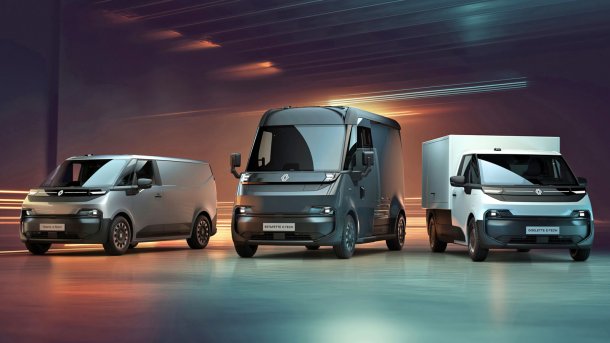
Renault's electric van series Estafette, Goelette and Trafic
(Image: Renault)
Renault is presenting three electric vans in the light commercial vehicle segment, which are to be launched on the market from 2026. Their names Estafette, Goelette and Trafic are taken from the brand's history and refer to the proven qualities of comparable historical models; in the case of the Trafic, Renault speaks rather boldly of a "fourth generation".
With the Software Defined Vehicle (SDV), Renault is referring to an increasingly important achievement that can make the difference between success and failure, regardless of the hardware, as Volkswagen and other major brands are currently experiencing. The new Transporters are also the brand's first electric cars with scalable SDV architecture. They were developed by partner Ampere, with whom Renault already worked on its Renault 4 and Renault 5 E-Tech Electric battery-electric cars, which were launched at the end of 2024.
Trafic E-Tech Electric
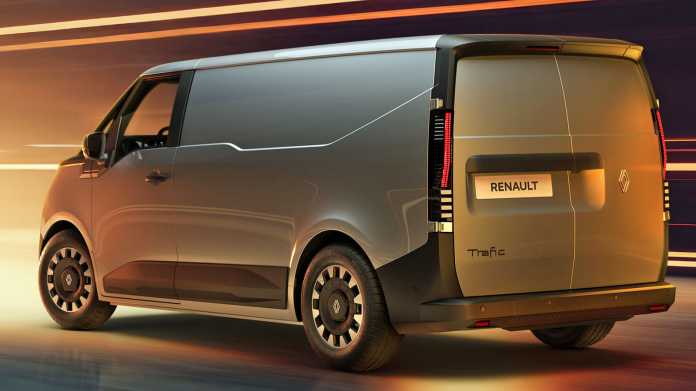
Renault describes the Trafic as the fourth generation of the van, more than 2.5 million of which have been sold since 1980, even though the two are no longer technically connected. The electric van takes the one-box design to a new level with a short front overhang and long wheelbase. This is made possible by the electric drive, which does not have the same spatial restrictions as the combustion engine. In other words: the wheels positioned far into the corners enable further improved space utilization.
Despite the long wheelbase, the turning circle is no larger than that of a Renault Clio, an invaluable advantage when making deliveries in urban areas. Renault has also taken this into account with a height of just under 1.9 meters, which allows the Trafic to enter almost all driveways and underground garages. In addition, there is a three-part windshield like the VW ID.Buzz and a lowered door window edge similar to the Mitsubishi L300. Both should improve visibility.
Renault elektrische Nutzfahrzeuge (6 Bilder)
Renault
)Black belt
In terms of appearance, Renault speaks of "flowing, structured lines", a generous description of what every model in automotive history has probably already claimed for itself. More important than "the waistline, which conveys a subtle impression of movement and energy even when the vehicle is stationary", is probably the mention of the asymmetrical gullwing doors. Despite everything, the Trafic remains more of a commercial vehicle than a futuristic sculpture. In any case, Renault has thought about the protection of the bodywork, which is actually essential for urban terrain, especially in France's metropolitan jostling zones: it extends from the front and rear bumpers to the lower door areas.

Goelette E-Tech Electric
In this country, "Goelette" is only known to older people or Renault nerds. This compact and versatile van was in widespread use from 1956 to the mid-1960s. The Goelette E-Tech Electric aims to build on this and will be available from 2026 in three versions - chassis, box and tipper - to meet a wide range of transportation needs. "A wide range of conversions" on this basis should open up further customer groups.
The Goelette E-Tech Electric is based on the technology of the Trafic E-Tech Electric and offers space behind the B-pillar for the aforementioned configurations as well as special solutions tailored to the specific requirements of certain users. The Goelette E-Tech Electric is therefore available with or without a running board, writes Renault.
Estafette E-Tech Electric
The Estafette E-Tech Electric is not only inspired by the name of the legendary Renault van from the 1960s. Renault built over half a million Estafettes between 1959 and 1980 over several vehicle generations. Even today, it is a vehicle that offers somewhat larger volumes than the Goelette and especially the Trafic, which is still somewhat more compact in almost all cases. At 5.27 m long, 2.60 m high and 1.92 m wide, this model is more spacious, but should still be "easy to steer through the narrow streets of city centres", as Renault emphasizes.
A person up to 1.90 m tall can sit upright in the cockpit and load compartment. A sliding door on the side is intended to enable smooth opening, and the one-piece rouleau at the rear also fits in with the almost silent movement of the electric car and does not require any more space to open than the tailgates or gullwing doors that are common in this class. Running boards on both sides and at the rear make it easier to get in and out. The Estafette is also equipped with body protection from the front and rear bumpers to the lower door areas. Equipped so that the usual contacts in urban use do not immediately lead to ugly battle scars.
Videos by heise
Market launch from 2026
Renault has not yet provided any technical data beyond that mentioned in the article and refers to upcoming publications. However, a technical relationship with the Renault 4 and 5 E-Tech Electric in terms of drive and storage technology is likely. The manufacturer will produce the battery-electric light commercial vehicles in France at the Sandouville plant. They are due to be launched on the market from 2026. The manufacturer intends to announce further details in the coming months. The overall development was in the hands of Flexis, an independent spin-off of Renault, the Volvo Group and CMA-CGM. The production site is the Sandouville plant in France.
(fpi)