

Superbike Kawasaki ZX-10 R on test: Less extreme than feared
A bike that has won the world championship six times in a row can only show its talent for a few seconds on the road. Its drive is a force to be reckoned with.
(Image: Kawasaki)
- Ingo Gach
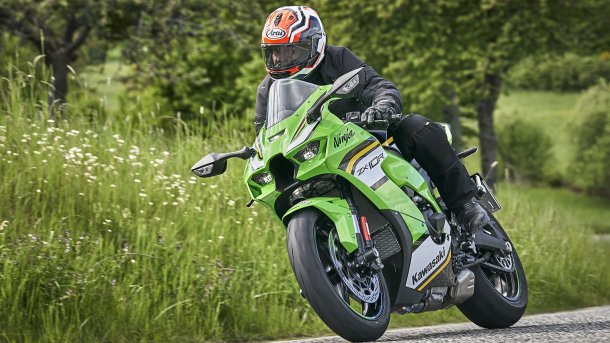
Even as a motoring journalist, it's not every day that you get the opportunity to ride the road version of a living legend. The Kawasaki ZX-10 R won the Superbike World Championship six times in a row from 2015 to 2020, always with Jonathan Rea in the saddle. It was simply unbeatable in its day. The current model also commands due respect, because if there's one thing Kawasaki can do, it's build powerful engines. In the case of the 998 cm3-cylinder in-line four of the ZX-10 R, we are talking about 203 hp on the dynamometer. But Kawasaki has left a large opening between the two LED headlights for the "Ram-Air" air funnel. When the wind pushes powerfully into the airbox in the wild, Kawasaki even promises 213 hp at 13,200 rpm.
- Derived from the World Championship Superbike
- Power: 157 kW at 13,200 rpm, torque 115 Nm at 11,400 rpm
- Top speed 298 km/h
- Price: 20,695 euros
Superior torque
Competitor models such as the BMW M 1000 RR, Ducati Panigale V4 R and Honda CBR 1000 RR-R have now reached 218 hp, but they have a poor chance against the ZX-10 R, which is weaker in terms of performance. With a superior torque curve, the Kawasaki also offers the highest value with 115 Nm at 11,400 rpm; no other production superbike with a displacement of one liter can keep up. For riding, this is more important than the pretty performance figures in the brochure. What makes it particularly appealing to me is that it doesn't have the huge winglets that look like pasted-on airplane wings on the competition. The ZX-10 R relies on winglets that are discreetly integrated into the fairing and do not spoil the design.
Not as extreme as I feared
So I get on a motorcycle that was designed for use on the race track and want to find out how it performs in normal road traffic. Even if it means shooting sparrows with cannons, there are always people who buy a superbike but never ride it on a permanent circuit.

It's no surprise that the riding position on the ZX-10 R is sporty, but the body position is nowhere near as extreme as I feared. Although there is a noticeable weight on my wrists, the stub handlebars are not positioned so ultra-low that it would hurt and they are also turned pleasantly far outwards, making it easier for me to turn.
High seating position
The rear of the ZX-10 R is noticeably high, 835 mm seat height is quite an announcement for a road motorcycle, but this also has a positive effect on the handling. Okay, the knee angle is tight in the long run, Kawasaki has placed the footrests so high for the racetrack that they do not touch the asphalt even at extreme lean angles. It is easy to crawl behind the windshield to minimize the surface area exposed to the storm at over 200 km/h. For the record: the vehicle registration certificate shows a top speed of 298 km/h.

Exemplary narrow seat
Underneath me is a 17-liter tank, which is bulbous at the front but provides a good and not too wide knee clearance at the rear. At the same time, the seat cushion is narrow at the front. This is important for racers when hanging off on the circuit. A five-inch TFT display provides me with at least the most important information – Speed, revs, gear indicator – easy to read, the others are quite small. Using the buttons at the left end of the handlebars, I can select the fixed riding modes in the menu and, if I wanted to, set all kinds of assistance systems in Rider mode: including throttle response, cornering ABS, slip control, engine braking torque and launch control.
Kawasaki ZX-10 R (8 Bilder)

Kawasaki
)Unmistakable sound
Enough looking into the cockpit, I start the engine. The sound is unmistakably that of an in-line four-cylinder: hoarse and you can hear the greed for revs with every gas stroke, although with a stationary noise level of 95 dB(A) it is still perfectly acceptable in the city. Engaging first gear is reasonably smooth and the clutch doesn't require much manual force. Nevertheless, I rarely use the clutch lever afterwards because the ZX-10 R is equipped with an excellent quickshifter that sorts the gears in both directions quickly and without banging the gearbox.
207 kg want to be actively moved
I initially stay in Road mode. The throttle response is pleasantly smooth and yet full power is available, which puts the slip control system on high alert. Fortunately, it is dry and the Bridgestone Racing Street RS11 finally gets up to temperature after a few kilometers to build up enough grip for the country road chase.
Empfohlener redaktioneller Inhalt
Mit Ihrer Zustimmung wird hier ein externer Preisvergleich (heise Preisvergleich) geladen.
Ich bin damit einverstanden, dass mir externe Inhalte angezeigt werden. Damit können personenbezogene Daten an Drittplattformen (heise Preisvergleich) übermittelt werden. Mehr dazu in unserer Datenschutzerklärung.
A superbike requires more physical effort to move fast, if only because of the forward-leaning riding position. The 207 kg kerb weight of the ZX-10 R needs to be moved actively, extreme agility is not to be expected from a 1000cc superbike, as this could quickly degenerate into nervousness on the race track. With a wheelbase of 1450 mm, a steering head angle of 65 degrees and a trail of 105 mm, the developers have opted for the golden mean between maneuverability and stubborn straight-line stability. The powerful aluminum frame also offers great stability reserves.
Hits the line precisely
The Kawasaki hits the line precisely and is absolutely stable when leaning. When accelerating out of a corner, I can pull the throttle grip firmly and the slip control noticeably prevents the rear wheel from spinning and breaking away. It goes without saying that the superbike engine has far too much power for public roads. If I were to use even the long first gear at full throttle, I would already be well beyond the permitted top speed. On the country road, I usually find myself in gears two to four in the middle speed range. The four-cylinder engine can easily reach a speed of 100 km/h in sixth gear without juddering, but that's not what it's designed for.
Sensitive chassis
It is surprising how sensitively the fully adjustable suspension with its Showa components absorbs bumps in the asphalt on the country road. The ZX-10 R is, of course, set up tightly, but hard impacts don't really penetrate. Unless there is a large hole in the road surface, then the springs with their working travel of 120 mm at the front and 115 mm at the rear reach their limits. For the radial brake callipers on the front wheel, Kawasaki continues to rely on the M50 monobloc brake callipers from Brembo instead of the newer Stylema components from the same brand. The effect is still very impressive. However, I am surprised that the ZX-10 R does not have steel-flex brake lines.
Road mode preferred
After riding the ZX-10 R on country roads in Road mode for a while, I switch to Sport mode. The in-line four-cylinder now responds more directly to the throttle, but this also makes the bike more nervous at the exit of corners. The assistance systems now allow more slippage, but still reliably prevent dicey situations. In the end, I decide to return to Road mode because it is more pleasant to ride. Sport mode is intended for people who want to ride on the racetrack but don't want to bother with fine adjustments. Incidentally, the rider does not have to worry about the temperature balance of the engine. In addition to liquid cooling, the Kawasaki also has an oil cooler – Like so many other things, the ZX-10 R has adopted this from its many years of experience in racing, as well as the Öhlins steering damper.
Videos by heise
The RR for racetracks
With the ZX-10 R, Kawasaki offers a very interesting sports bike with a high level of performance. However, if you are serious about riding on the racetrack, Kawasaki offers the even more uncompromising ZX-10 RR. Among other things, it has adjustable-length intake funnels for more power in the lower rev range, titanium pistons and connecting rods, sharper camshafts, modified gear ratios and forged rims from Marchesini.
The question remains as to who the ZX-10 R is for. The price answers that. It is available for 20,695 euros, while the ZX-10 RR costs 29,995 euros. A surcharge of almost 50 percent only makes sense for Kawasaki fans who want to go racing. Everyone else is well served by the ZX-10 R on the country road and for occasional visits to circuits.