

Electric car Subaru Solterra put to the test: Electrically disappointing
Seite 2: Subaru Solterra in test: Disappointing charging performance
The same applies to the charging performance. It is true that many solutions, such as the clicky and reliable locking mechanism for the cable (unfortunately, it has to be mentioned positively when an electric car communicates correctly at all charging stations in the test), are consistently well thought-out. However, this cannot hide the consistently low speed. On the AC side, there is currently only 7 kW of charging power, which is also limited to one phase. At home, there is usually only a maximum of 4.5 kW due to the limitation of the unbalanced load, and even only 3.7 kW at an 11-kW wallbox, which distributes its power over three phases. The lame AC charging speed makes storage charging at public pillars in Hamburg almost unusable: Here, only two hours of standing time are allowed. After this time, no 100 km of range are added.
Subaru Solterra Loading (4 Bilder)
DC charging power too low, route planning inadequate
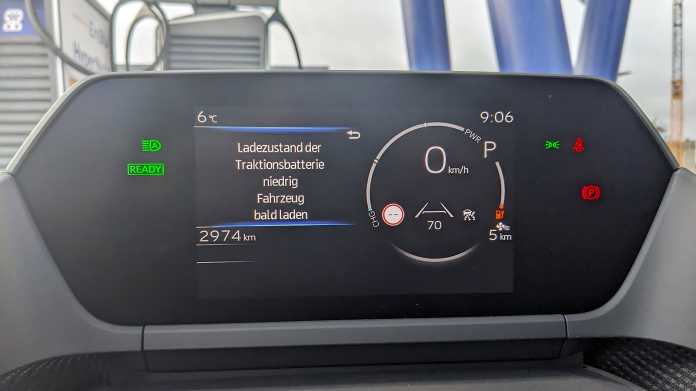
So I charged almost continuously with direct current. Subaru cleverly avoids an exact factory specification and talks about a round half hour to 80 percent charge level - and omits from which lower point it started. In any case, the test car had a constant cold problem despite clear plus degrees. I once drove the Solterra down to five remaining kilometers and then plugged it in at an EnBW charging station with charging curve recording. It started with 60 kW, increased to a good 105 kW in the meantime, dropped slowly, and then radically closed down from 80 percent SoC: Then ten kW are no longer possible.
What the Subaru Solterra lacks, among other things, is automatic and targeted preconditioning of the traction battery for the DC charge stop. Volkswagen doesn't have that yet either. At least the MEB electric cars automatically calculate where to stop on a long route. With the Solterra, this can only be done manually and laboriously. It is incomprehensible that a navigation system that is obviously as powerful as the one in the Subaru does without this software function.
Conclusion: an ambivalent picture
As a result, the Subaru Solterra is not a recommendation for the long distance. The competition is further ahead here. No SoC display, no calculation of the charging stops, no preconditioning - all things that can be fixed via update. I understand the cautious design of the charging current, but as an imaginary buyer I would also want to have the advantage in the form of a particularly long warranty. However, this does not go beyond the usual eight years and 160,000 km for 70 percent of the original capacity.
Thus, the Solterra left me with an ambivalent impression. It has a high-quality build, is logically designed and drives directly and comfortably at the same time. I like that just as much as the driving assistants. I admit that I personally like the brand. However, the power consumption in connection with the too low charging speed are unreasonable. The fact that several software features that are elementary for an electric car are missing is evidence of a certain lack of love - and it confirms the prejudice against Toyota, which is identical in construction: It's as if the company that built the most cars worldwide in 2022 wants to continue to sell electric cars only tentatively. That reflects on Subaru.
The manufacturer provided the test car free of charge and transferred it. The editors paid for the traction current.