

Basic technology in the electric car: types of three-phase motor
Battery technology has become the flag bearer for the electric car where the engine was for the combustion model.
(Bild: Audi)
(Hier finden Sie die deutsche Version des Beitrags)
The average efficiency of an internal combustion engine in real-world operation is measured at around 20 percent. 80 percent is lost as waste heat, of which only a small proportion is useful in winter as cabin heating. In a system like this, the efficiency gains of an electric car are very clear. Electric drives convert more than 80 percent of the energy in the storage unit into propulsion. Because there is hardly any waste heat, electric cars consequently need heating energy from the battery in winter. Added to this are charging losses of around 10 percent. These considerable differences in technology are the cause of the differences in experienced consumption behavior. The electric motor has been around longer than the reciprocating engine. Despite its long history, there have recently been new design ideas specifically for use in vehicles.
Electric motors: Power consumption has many influencing variables
The electric motors themselves convert 90 to over 95 percent of electrical energy into kinetic energy, so generally very little is lost at the engine. The efficiency of the car as a whole is determined by a large number of small cogs that are interdependent in a complex way. So when the efficiency of motors is discussed, keep in mind that they are just such cogs, and that the final power consumption depends more than on the motor on the battery, inverter, tires and above all on the aerodynamics. An efficient motor design can easily be driven inefficiently, and there are good reasons to build less efficient designs anyway.

(Bild: BMW)
Packaging advantages
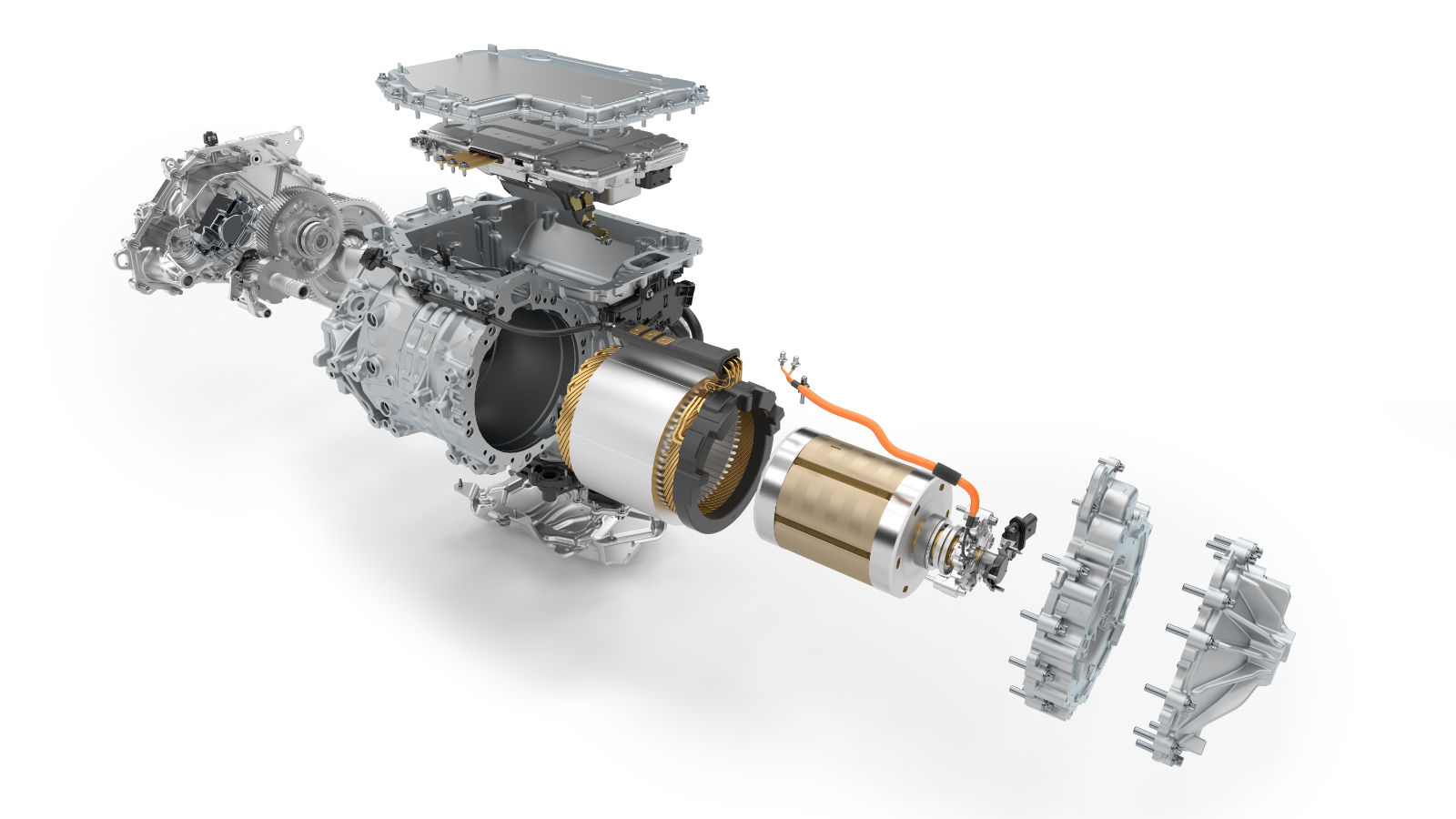
Compared to reciprocating engines, electric motors are very compact, very power dense. Their comparatively small volume with manageable waste heat emission makes it possible to pack them close to the axles and integrate them there with other components. This is then called an "integrated e-axle" and contains at least the motor, inverter and transmission - a popular solution with car manufacturers as well as suppliers such as Bosch or Schaeffler. Sometimes an axle differential is also added (for example at ZF). Thanks to their enormous packaging advantages, e-motors have brought another benefit in addition to the universally known efficiency that not everyone appreciates, but which nevertheless benefits everyone: the return of rear-wheel drive to the mainstream.

(Bild: BMW)
Driving the rear axle with one engine has enormous advantages in terms of steering, driving dynamics and thus driving safety. Front-wheel drive was always just a concession to utility, because the "donkey at the front - cargo space at the rear" design offers a high degree of loading freedom. Anyone familiar with the loading height of some station wagons with rear-wheel drive in comparison to their cargo donkey competitors knows this for a fact. But in the e-car, the battery needs space in the underbody anyway, which reduces the advantages of front-wheel drive. Instead of distributing the torque of one motor to four wheels, the electric motor also allows a separate motor to be fitted to each axle. A few particularly powerful cars like the Audi e-tron GT or Tesla's Model S Plaid even use three motors, two of them on the rear axle to distribute the torque - also known as torque vectoring.
Common features of all electric cars
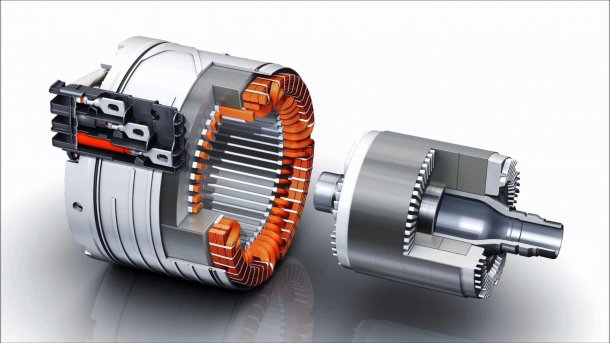
Electric motors work with coils, which (when supplied with current) build up a magnetic field. This magnetic field in the "stator" (because it is relative to the vehicle) moves a "rotor" influenced by it (because it rotates relative to the vehicle). The rotor is usually on the inside, but can also be on the outside in flat, wide designs such as wheel hub motors. There are electrically different ways to build electric motors, but in the electric car today only three-phase motors are used.

(Bild: Porsche)
"Three-phase current" means: alternating current on three phases, each with voltage amplitudes shifted by 120 degrees. You may be familiar with three-phase current from domestic engineering: three phases with 230 V against neutral (or with 400 V against each other), each phase 120 degrees out of phase with each other, this is how houses in Germany are connected to the low-voltage network. To ensure uniform torque output during motor operation, the phases are divided between coils in multiples of three and the magnetization properties of the rotor are adjusted accordingly. In the motor of the Mini Cooper SE, for example, the pull-in machine rolls 18 coils onto which the three phases are distributed.
High power density is achieved by winding the coils as tightly as possible, without crossing wires. This "slot filling" should be high because it determines the power behavior of the engine. For this reason, Porsche, BMW and Hyundai, for example, use rectangular coil wires, which increases the degree of filling from 45 to 50 percent with conventional winding to almost 70 percent. With a high slot fill ratio, the motor can also dissipate heat better.

(Bild: Porsche)
Electric car motors: Types excitation
The most widely used motor in electric cars is the "permanently excited synchronous motor" (PSM). "Permanently excited" simply means that the rotor turns a permanent magnetic field. It therefore consists of permanent magnets. PSMs are characterized by high power density and efficiency, which is why Formula E teams, for example, use this design. The rotor is usually built by inserting many small, strong magnets into a field-conducting soft-iron sheet stack that is pressed onto a steel drive shaft.
Videos by heise
Disadvantages: A permanent magnet cannot be switched off, so it always induces a voltage in the coils of the stator when it rotates, which can cause problems in the event of a fault (such as when towing with dead control electronics). In addition, the strong permanent magnets are made of neodymium-iron-boron. China dominates the neodymium world market with 95 percent, and also prefers to build the magnets itself.
(Bild: BMW)
Many manufacturers are aware of this dependence and therefore offer "separately excited" synchronous motors. Here, the permanent magnet is replaced by an electromagnet, i.e. by coils with soft iron cores. Power is supplied to the rotor coils either by sliding contacts or inductively. Good designs lose only one to two percent efficiency compared to variants with permanent magnets. In addition to the advantage of higher raw material independence, the motor controller can meter the field strength of the rotor by current supply, making this motor design very controllable (and causing fewer towing problems). Disadvantages: The additional construction cost for external excitation makes the motor more complex, and wipers are wear parts.
Synchronicity
The "synchronous" of the PSM in turn concerns the magnetic field in the stator in relation to the speed of the rotor. These two rotation rates run synchronously to each other (at constant load). The driving resistances that the motor overcomes result in an angle that the rotor trails the leading magnetic field. This "load angle" or "pole wheel angle" must not become too large, otherwise the synchronous guidance breaks down and the motor "tilts" (i.e. no longer supplies torque). In a very simple motor with only one magnetic pole pair this happens with a mechanical load angle more than 90 degrees, in more common designs in cars the (mechanical) angle depends on the number of pole pairs. In generator operation, then, it is the other way around: the rotor rushes ahead of its voltage pattern induced in the stator by a load angle that correlates with the resistances of the power generation.